Solution
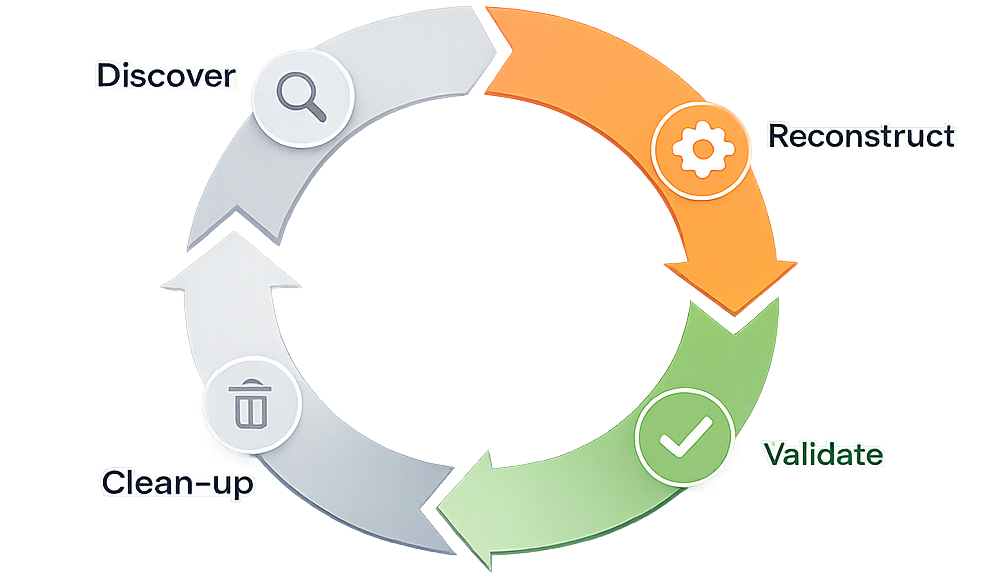
Phantom lets you:
- discover application components and changes.
- reconstruct production-like application twins.
- validate that the recreated application works.
- manage the full lifecycle of twin applications including automatic destruction and cleanup.
How does it work?
In the Phantom model, applications are composed of components (e.g. an API housed in a K8s pod).
Components live in runtimes (e.g. K8s cluster) and an environment is a collection of runtimes.
Applications may span heterogeneous runtimes.
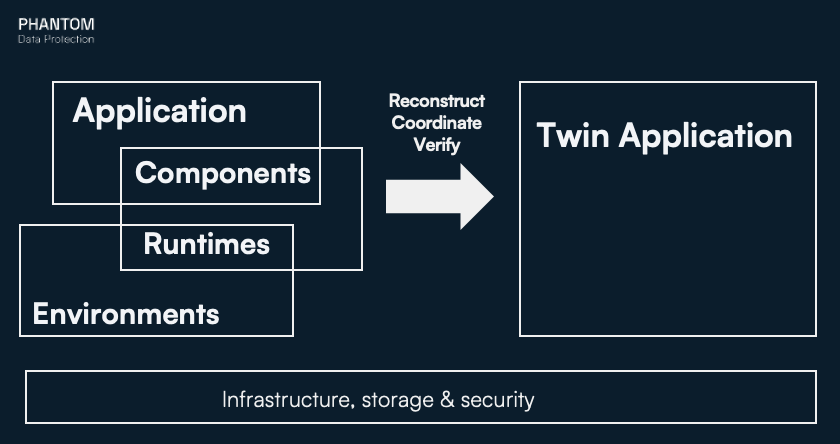
Phantom continuously captures dependencies, state and topology.
Phantom reconstructs application components into isolated twin applications.
It coordinates runtime and dependency ordering and reconstructs stateful systems using runtime-native semantics and verifies operational readiness.
Twin applications and components can be validated, tested, promoted or discarded.
Infrastructure, storage, and security systems provide the supporting layer.
That layer is responsible for runtime agents, object storage and encryption.
It's also responsible for reconstruction-metadata and orchestration-state.
Phantom currently supports:
- Kubernetes runtimes
- Proxmox VMs and LXC containers
- PostgreSQL runtime capture and PITR
- Managed PostgreSQL or nested in a Kubernetes or Proxmox cluster
- Vendor agnostic public and private cloud storage (e.g AWS S3, Google Cloud Storage, MinIO)
- Vendor agnostic key management services (e.g. AWS KMS, Google Cloud KMS)
Reconstruction is coordinated using application topology and runtime relationships.
Dependency sequencing and consistency metadata is also used. Reconstruction is deterministic.